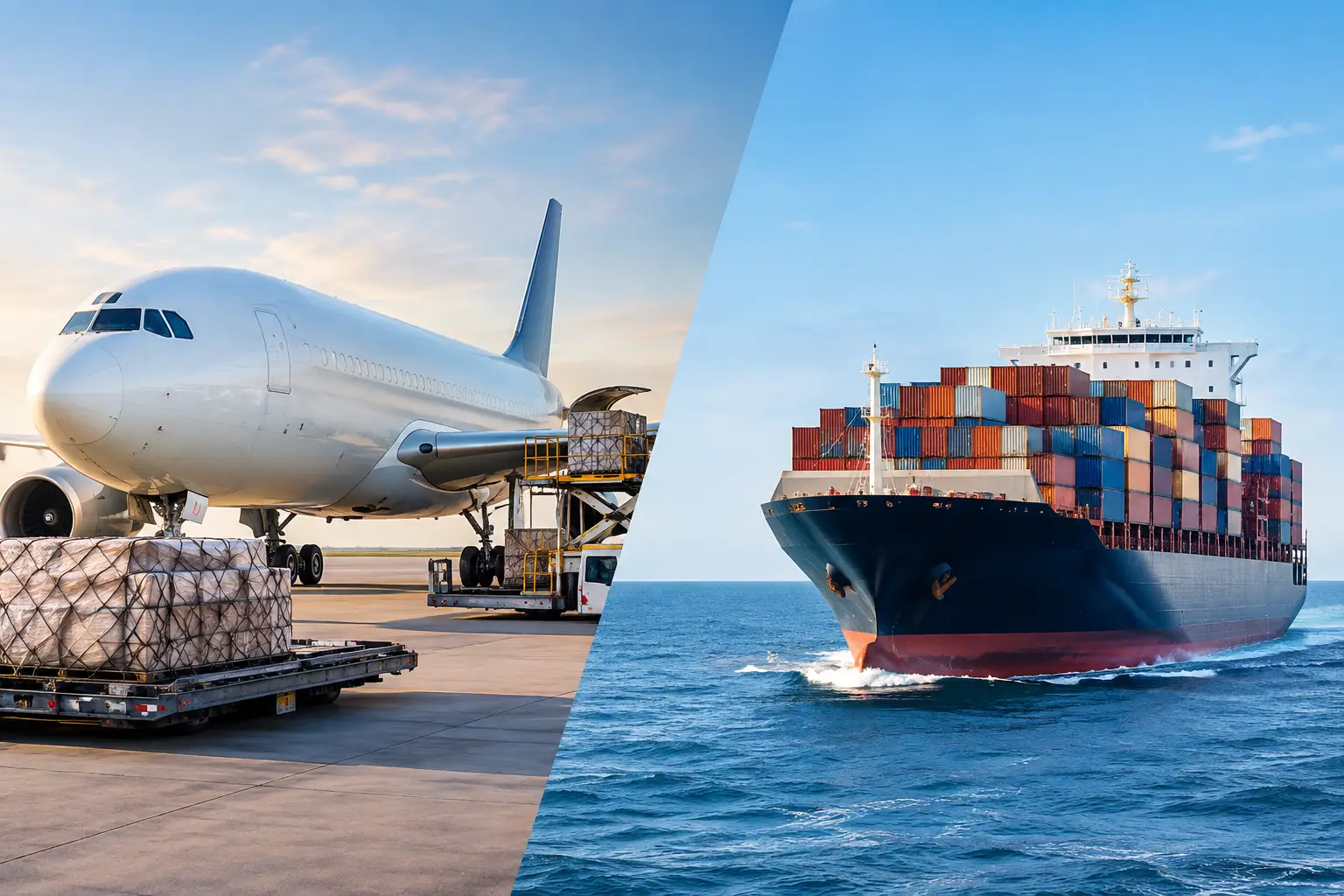
Air Freight Versus Sea Freight: Which Fits?
A delayed container can leave a retailer without stock at the start of its strongest selling period. Flying the entire order may protect revenue, but can remove the margin that made the product viable. That is the commercial decision behind air freight versus sea freight: not simply which mode is faster or cheaper, but which one protects your customer promise, working capital and long-term supply plan.
For businesses importing from China and wider Asia, freight should be decided before production is complete. Carton dimensions, order volume, destination, product value, customs requirements and sales forecasts all influence the right answer. The most effective approach treats logistics as part of product and sourcing strategy, rather than a final booking task.
Air Freight Versus Sea Freight: The Core Difference
Air freight moves cargo from airport to airport, with final collection or delivery arranged separately where required. It is designed for speed and is generally charged by chargeable weight, which is the greater of actual weight or volumetric weight. Large but light goods can therefore be expensive to fly.
Sea freight moves goods in either a full container load (FCL) or less than container load (LCL) shipment. FCL gives one buyer dedicated use of a container. LCL combines cargo from several shippers, reducing the entry cost for smaller volumes but adding consolidation and deconsolidation steps. Ocean freight is normally priced around container size or cargo volume, making it much more economical for bulky, heavier products.
The headline comparison is straightforward: air freight is faster, while sea freight offers materially lower transport cost per unit. The operational reality is more nuanced. A shipment must be ready, booked, exported, carried, cleared and delivered. Port congestion, sailing schedules, peak-season capacity, airport screening, customs holds and inland transport can all change the final transit time.
When Air Freight Is the Commercially Sound Choice
Air freight is appropriate when lost sales, contractual penalties or a production interruption would cost more than the additional freight charge. It is often used for product samples, first production articles, replacement components, urgent replenishment and high-value goods with favourable weight-to-value ratios.
For example, a compact electronic accessory with strong margins may absorb air freight during a launch period. A fashion brand might fly a controlled quantity of an approved collection to meet a campaign date while the balance travels by sea. This protects availability without turning an entire seasonal order into an expensive air shipment.
Speed is not the only advantage. Air freight can reduce inventory held in transit and shorten the cash-to-cash cycle. For a business with reliable demand data and frequent replenishment, smaller, faster deliveries may reduce the need to commit capital to several months of stock. However, this benefit only holds when the supplier can produce consistently, booking capacity is secured early, and the destination operation can process goods without delay.
Air freight also demands close attention to packaging and product classification. Dimensional weight can quickly exceed physical weight, particularly for boxed consumer goods, lightweight furniture, promotional displays and products with inefficient inner packaging. Batteries, liquids, magnetic items and other regulated goods may face additional documentation, packing and carrier restrictions. A quote that looks viable before measurements and dangerous-goods checks can change significantly once cargo is accepted.
When Sea Freight Creates Better Value
Sea freight is normally the right foundation for planned replenishment, larger purchase orders and products where freight represents a meaningful share of landed cost. Furniture, household goods, tools, packaging, textiles, fitness equipment and other volume-heavy categories generally benefit from containerised shipping.
A full container load is particularly effective when order volume is sufficient and production can be co-ordinated to load efficiently. It reduces handling between origin and destination compared with LCL, gives greater control over how cargo is packed, and can simplify cargo segregation. Container utilisation matters: unused space still carries a cost, while poor loading can increase damage risk and make destination unloading inefficient.
LCL can be useful for smaller orders, mixed product ranges or early-stage brands that are not yet ready to commit to a full container. It should not automatically be viewed as the low-cost option. Origin handling, consolidation, documentation, destination charges and local delivery can make LCL disproportionately expensive for cargo nearing FCL volume. The comparison should always use a complete door-to-door landed-cost calculation, not an ocean rate alone.
Sea freight requires more planning. From Asia to the UK or continental Europe, port-to-port transit may take several weeks, with the total door-to-door timeline extending further once origin collection, export formalities, terminal handling, customs clearance and final delivery are included. Seasonal disruption can also be significant. Chinese New Year, Golden Week, peak retail shipping periods and weather-related port congestion should be reflected in purchase-order timing.
Look Beyond the Freight Rate
The best transport decision is based on total cost and business exposure. A low sea-freight rate has limited value if stock arrives after the selling window. Equally, a rapid air shipment can be a poor decision if it conceals weak forecasting, late supplier approval or avoidable production delays.
A proper comparison should account for product cost, export charges, freight, cargo insurance, customs duty, import VAT, clearance, storage, palletisation, final-mile delivery and the cost of capital tied up while goods are in transit. It should also account for the consequences of failure: lost marketplace ranking, a missed wholesale delivery, stockouts, production downtime or customer refunds.
Incoterms need equal attention. The agreed Incoterm defines responsibilities for transport, risk transfer and costs at specified points in the journey. It does not replace a clear freight plan or remove the importer’s responsibility to understand customs compliance. Businesses should confirm who controls the booking, which charges are included, who is named as importer of record where applicable, and how customs documents will be checked before cargo departs.
A Practical Decision Framework for Importers
Start with the delivery date the business genuinely needs, then work backwards. Include production lead time, quality inspection, rework allowance, booking cut-offs, export handling, transit, customs clearance and delivery to your warehouse or fulfilment centre. If the date leaves no contingency, the problem may be planning rather than freight mode.
Next, assess the product itself. High-value, compact and time-sensitive products are stronger candidates for air freight. Heavy, bulky and forecastable lines normally belong on the water. Measure final packed cartons, not estimated product dimensions, and calculate both cubic volume and chargeable air weight before deciding.
Then consider whether the shipment can be split. A common and effective strategy is to fly a limited quantity to cover immediate demand while moving the main order by sea. This is especially useful after a delayed production run or when launching a new line with uncertain sales velocity. The split must be planned carefully so that packing lists, customs entries, labelling and inventory records remain accurate.
Finally, test the decision against supply-chain resilience. If one delayed vessel would stop sales completely, holding no buffer stock may be a larger risk than the freight saving. If demand is volatile, ordering too far ahead by sea can create excess inventory. The right balance differs by category, margin, seasonality and the reliability of both supplier and forecast.
Freight Planning Begins at the Factory
Transport performance is often determined well before cargo reaches a port or airport. Goods must pass inspection, be packed to specification, carry correct labels, and be supported by accurate commercial invoices, packing lists and compliance documents. A rushed freight booking cannot compensate for unfinished production, inadequate export cartons or missing test reports.
This is where integrated sourcing oversight has practical value. EC4U co-ordinates supplier readiness, quality control, consolidation and shipping planning so that logistics decisions are based on verified production status rather than assumptions. For multi-supplier orders, consolidation can reduce fragmented deliveries and improve container utilisation, provided each factory meets the agreed handover date and packaging standard.
Freight is not a binary choice between cheap and fast. It is a controlled decision about timing, cost and risk. Build the preferred mode into your purchase plan, retain an air-freight contingency for genuine exceptions, and make sure every shipment leaves the factory with the quality, documentation and delivery plan needed to reach your customer as promised.